


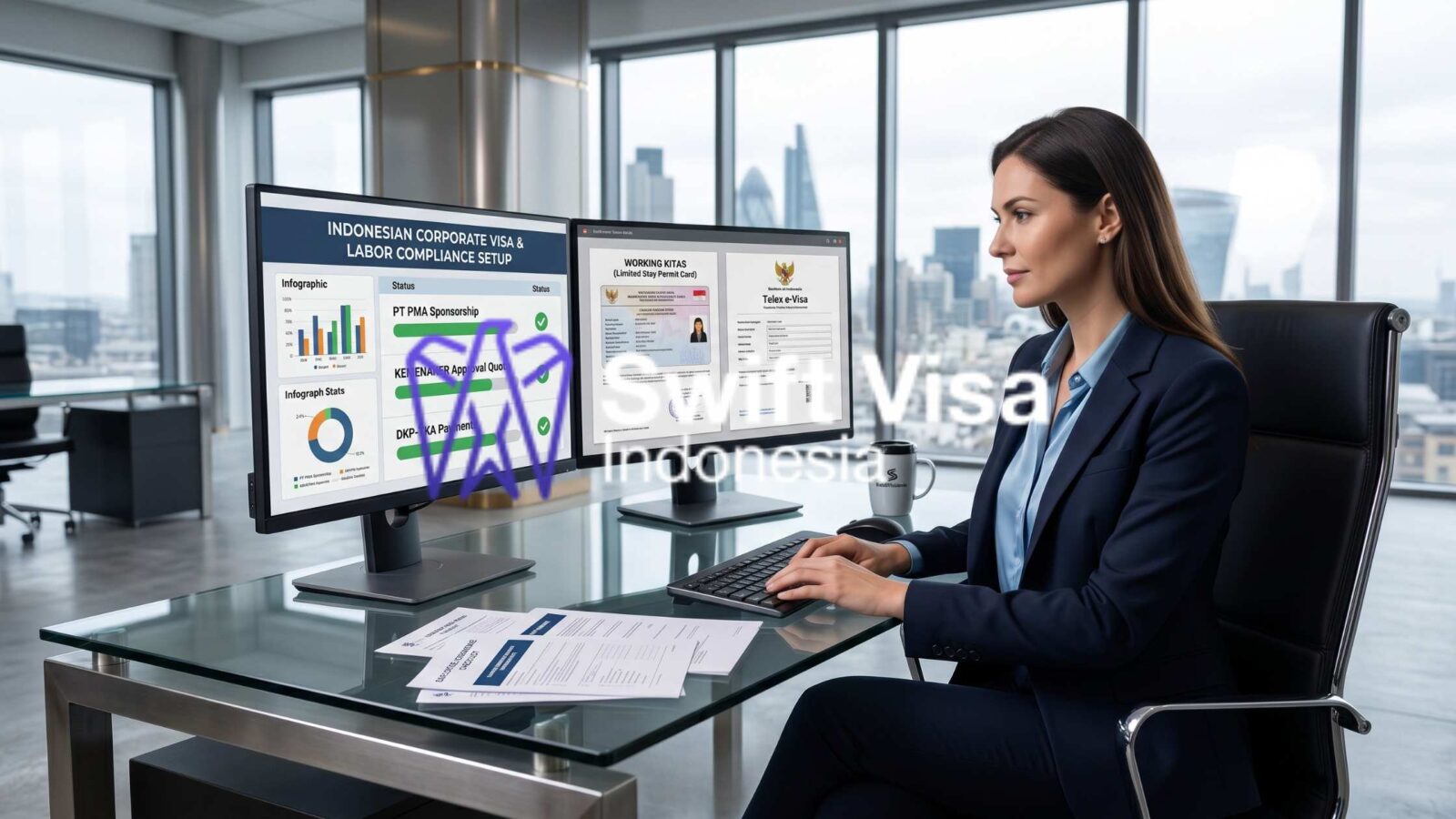
For multinational corporations scaling operations or setting up new subsidiaries in Indonesia, mobilizing international talent is a critical driver of business growth. Whether you are transferring top-tier executives from the United States or deploying specialized technical engineers from Europe, understanding the mechanisms of a Foreign Employee Visa in Indonesia is vital for safeguarding corporate compliance.
The Indonesian government maintains strict regulatory oversight on the employment of expatriates. The primary objective is to protect the domestic labor market while facilitating legitimate foreign investment.
For international HR departments, navigating the administrative boundaries set by the Ministry of Manpower (Kementerian Ketenagakerjaan / Kemenaker) and the Directorate General of Immigration is a complex but necessary process. This article details how to secure a Working Visa Indonesia compliantly while avoiding common legal pitfalls.
Navigating the Dual-Agency Approval System
Securing a legal corporate visa requires a sequential, multi-agency approval process. A common misconception among foreign companies is that a business visa suffices for operational work. In reality, any activity that generates local revenue or involves hands-on corporate management demands a comprehensive Indonesia Work Permit and an associated residence permit.
The application involves two distinct regulatory pillars:
1. Kemenaker Compliance (The Labor Market Test)
Before any visa can be authorized, the sponsoring corporate entity (which must be a legally registered structure, such as a PT PMA) must prove that the position assigned to the foreign national cannot currently be filled by a local citizen. Your organization must justify the expatriate’s placement by detailing their niche expertise and outlining a clear local transfer-of-knowledge framework.
2. Directorate General of Immigration (Border Control)
Once Kemenaker issues the labor approval (via the Notification system), the process moves to the immigration portal. This step converts your labor approval into an electronic entry visa (e-Visa) and, ultimately, a Working Visa Indonesia (Working KITAS) upon the employee’s physical arrival in the country.
Strict Boundaries: Restricted Positions for Foreign Workers
To maintain corporate compliance, global mobility teams must design recruitment strategies that respect local legal boundaries. Under current labor regulations, certain departments and roles are strictly closed to foreign passport holders.
- Prohibited Roles: Foreign nationals are legally restricted from holding positions within Human Resources (HR), Personnel Management, Industrial Relations, and Occupational Health and Safety (K3).
- Permitted Corporate Roles: Expatriates are widely permitted to occupy C-Suite executive seats (Directors, Commissioners), assume roles as regional asset managers, or serve as technical advisors, specialized software engineers, and project consultants.
Ensuring your candidate’s official job title matches an approved category on the Kemenaker occupational list is paramount. A mismatch can result in immediate application rejection.
Structural Requirements for Sponsoring Entities
An enterprise cannot sponsor a Foreign Employee Visa Indonesia unless its corporate structure satisfies specific financial and administrative prerequisites via the Online Single Submission (OSS) system.
[Minimum Sponsoring Criteria for PT PMA]
├── Paid-Up Capital: Minimum IDR 10 Billion (~$630,000+ USD)
├── Ratio Constraint: Maintenance of local-to-foreign employee ratios
└── Fiscal Health: Clear corporate tax reporting history (SPT Pajak)
Additionally, for every foreign national employed under a standard Corporate Visa Indonesia, the sponsoring company must contribute to the Skill Development Fund Levy (DKP-TKA). This government mandate requires a flat-rate payment of $100 USD per month per employee, paid upfront annually ($1,200 USD per year) to support the training of local workforces.
Proactive Risk Management for Global Enterprises
Non-compliance with Indonesian labor laws carries severe administrative and criminal liabilities. Conducting hands-on operational work on an incorrect visa classification (such as an on-arrival tourist visa or standard business visa) can lead to corporate fines, immediate deportation of personnel, and temporary blacklisting of the enterprise.
To streamline global mobility workflows, enterprise HR directors should implement the following operational safeguards:
- Initiate Early Project Timelines: Due to document legalizations, translation requirements, and multi-agency evaluations, start the recruitment and onboarding immigration pipeline at least 45 to 60 days before the scheduled relocation date.
- Verify Educational Credentials: Kemenaker requires foreign workers to possess a university degree relevant to the specific job title being applied for, alongside a minimum of 5 years of documented work experience in that field.
- Implement Local Shadowing: Ensure your corporate structure assigns local Indonesian counterparts to “shadow” the incoming foreign worker to satisfy the transfer-of-knowledge compliance metrics.
Secure Your Sponsoring Framework with SwiftVisaIndo
Navigating Indonesian immigration structures from an international corporate headquarters requires local administrative presence and legal precision.
At SwiftVisaIndo, we specialize in managing corporate immigration workflows for multinational enterprises and foreign investment firms. From auditing your PT PMA setup documents to securing end-to-end approvals for your Working Visa Indonesia, our experienced legal consultants handle the administrative complexities on your behalf.
Consult with SwiftVisaIndo’s Corporate Immigration Team Today to establish a seamless, fully compliant visa framework for your international workforce.