


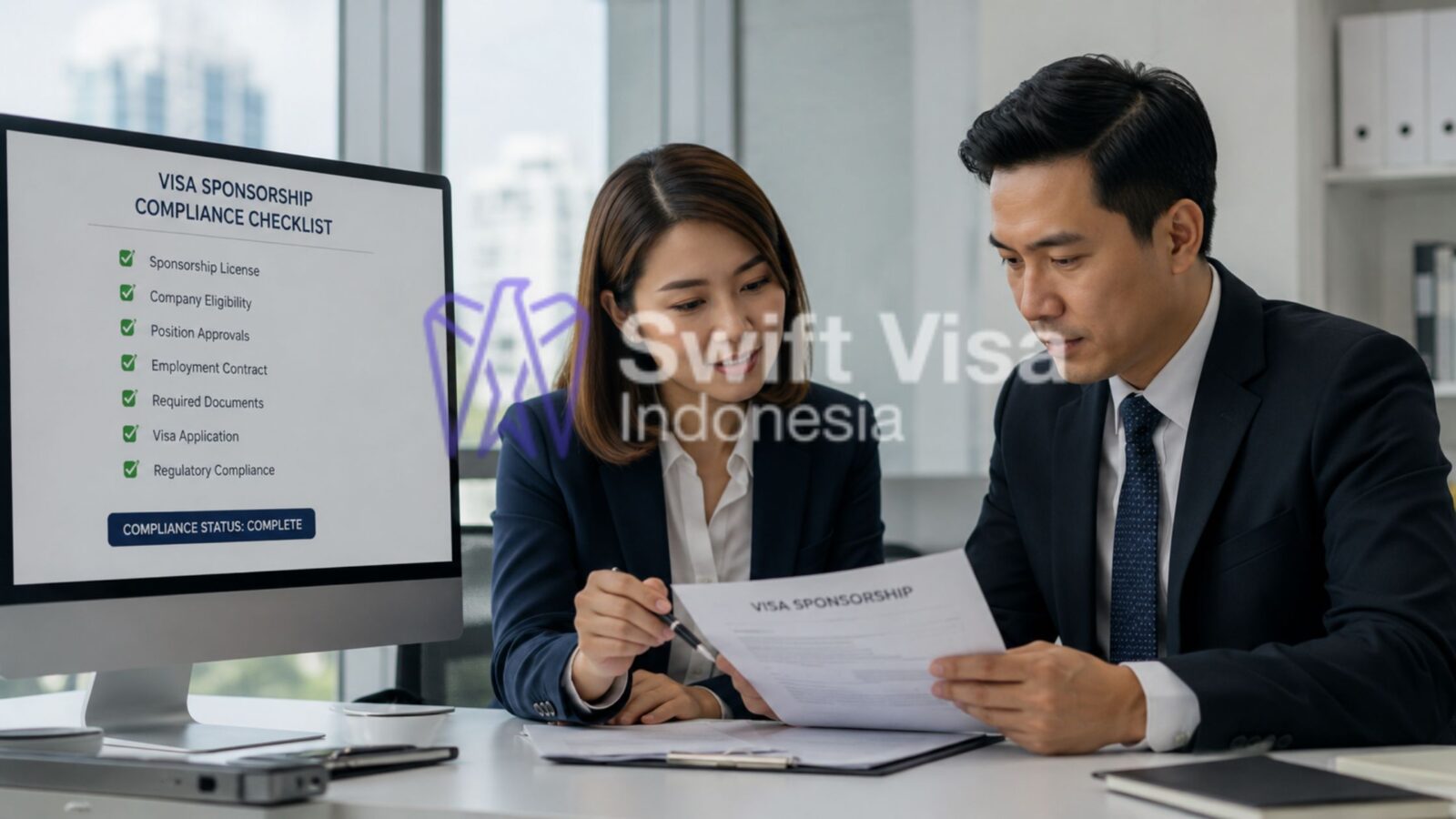
Most companies treat visa sponsorship as a milestone: documents filed, approval received, employee onboarded, done. In practice, sponsorship in Indonesia opens a continuous legal relationship between employer, employee, and immigration authorities — one that stays active for as long as the foreign employee remains on the company’s sponsorship, and doesn’t fully close until exit procedures are properly filed.
This guide covers what a Company Sponsored Work Visa Indonesia actually obligates your company to do — from the moment you decide to sponsor a foreign hire through to the day their employment ends.
Why Sponsorship Is Mandatory, Not Optional
Foreign nationals cannot independently apply for a work permit in Indonesia. The law requires sponsorship by a registered Indonesian corporate entity — a PT PMA or qualifying local company — that formally guarantees the employee is qualified, will contribute to the company’s operations, and will comply with Indonesian law throughout their stay.
This is different from an independent (self-sponsored) application, which some freelancers, entrepreneurs, or project-based consultants use instead:
| Criteria | Company Sponsored | Independent Application |
| Sponsor | Registered company | Individual (self-sponsored) |
| Legal Responsibility | Employer | Applicant |
| Visa Type | KITAS (Index 312/313/316, depending on role) | Limited Stay Visa (personal) |
| Renewal | Managed by HR or visa consultant | Applicant renews personally |
| Compliance Risk | Lower — corporate oversight and structure | Higher — no legal representative backing the applicant |
For long-term corporate employment — expatriate staff, parent-company transfers, long-term consultants and executives — company sponsorship is both the legal requirement and the more stable path for the employee.
Before You Can Sponsor: Corporate Eligibility
Your company must confirm it’s authorized to sponsor before initiating any application:
- NIB (Business Identification Number) must specifically permit foreign worker placement (penempatan TKA)
- Company Deed of Establishment must be current, with annual tax reporting (SPT Tahunan) and manpower reports (WLKP) filed on schedule
- Local-to-expat ratio — the general guideline is roughly 10 local employees for every 1 sponsored foreign expert, though the specific ratio varies by sector
Companies that skip this pre-check often discover eligibility gaps only after investing time in the RPTKA application — a costly and avoidable delay.
The Enterprise Work Permit Scope for Multi-Hire Sponsorship
For companies bringing in multiple expatriates at once — a new tech division, a resort chain expansion, a multi-role project team — sponsoring visas one at a time quickly becomes a logistical bottleneck. Structuring your company’s RPTKA quota to accommodate several foreign hires simultaneously, rather than filing sequentially, can save months of cumulative processing time and keep an entire team’s start dates aligned.
Mandatory Job Vacancy Posting
Before RPTKA can be approved, the company must first demonstrate that no qualified Indonesian candidate is available for the role:
- The HR department posts the vacancy on the Ministry of Manpower’s “Siap Kerja” portal (and typically other approved local job boards)
- The posting period runs 10–14 days
- If no qualified local applicant applies within that window, the company may proceed to sponsor the foreign hire
Skipping or shortening this step is one of the most common — and most avoidable — causes of RPTKA rejection.
Employer Obligations Once Sponsorship Begins
Sponsorship carries three specific legal and financial obligations that continue for the duration of the employment.
1. The DKP-TKA / DPKTKA Levy
The Skill Development Fund (known interchangeably as DKP-TKA or DPKTKA depending on the source) is a mandatory government contribution set at USD 100 per month per sponsored worker, paid upfront for the approved permit duration — USD 1,200 for a standard 12-month permit.
2. Companion Worker Requirement (Tenaga Kerja Pendamping)
Indonesian labor law requires a formal “transfer of knowledge” component: for every foreign expert sponsored, the company must officially appoint at least one local Indonesian employee as a companion worker, and submit periodic reports demonstrating the foreign expert is actively training that counterpart. This requirement is frequently underestimated by first-time sponsors and is a common trigger for compliance review if reporting lapses.
3. Exit Permit Only (EPO) and Repatriation
When a sponsored employee resigns, is terminated, or completes their contract, the sponsoring company — not the employee — is legally responsible for processing the Exit Permit Only (EPO) that formally cancels the work permit. The company also bears responsibility for ensuring the employee actually departs Indonesia, including repatriation flight costs if required. Sponsorship obligations do not end when the employee stops showing up to work; they end when the exit is formally processed.
Sector-Specific Variations
A handful of sectors carry additional regulatory layers on top of the standard RPTKA process:
| Sector | Additional Approval Required | Compliance Nuance |
| Oil & Gas (Migas) | SKPP Migas | Strict age and experience requirements |
| Finance & Banking | OJK (Financial Services Authority) | Rigorous fit-and-proper tests |
| Education | Ministry of Education & Culture | Verification of specific teaching certifications |
If your sponsored hire falls into one of these sectors, budget additional review time beyond the standard RPTKA timeline.
The Compliance Lifecycle: Where Companies Underestimate Risk
Sponsorship risk doesn’t concentrate at a single point — it accumulates across four phases:
Pre-arrival exposure: job scope definitions that are too broad or don’t match actual duties, or documentation that doesn’t reflect operational reality.
Active employment: unclear reporting lines, role changes made informally without updating official records, or missed permit renewal deadlines.
Detection: when discrepancies surface — whether through routine audit or renewal review — consequences rarely stay limited to the individual case. They can trigger increased scrutiny of the company’s future applications overall.
Exit: failing to report a role change, termination, or contract completion promptly is one of the most common sources of issues that only surface later, during a subsequent audit or the next sponsorship application.
Control measures that prevent this: centralized tracking of every sponsored employee’s visa/KITAS validity, clear alignment between the approved RPTKA role and actual day-to-day activities, defined internal procedures for renewals and exits, and consistent documentation across HR, legal, and immigration filings.
Common Mistakes to Avoid
- Submitting incomplete RPTKA documentation
- Applying under the wrong visa index (312 vs. 313 vs. 316 — each corresponds to a different employment category, and using the wrong one triggers delays)
- Overlooking NPWP (tax ID) registration for the sponsored employee
- Allowing KITAS to lapse without initiating renewal in advance
A Practical Example
A Singapore-based technology company expanding into Jakarta needed to sponsor 25 foreign developers for a new engineering hub. Rather than filing each application individually — the default approach with their previous provider — they consolidated the RPTKA quota and processed the group as a coordinated enterprise sponsorship. The result: full compliance across all 25 permits, zero penalties, and onboarding completed roughly 40% faster than their prior single-application approach.
Frequently Asked Questions
Can a foreign employee switch employers while on a company-sponsored visa? No — the KITAS is tied to the sponsoring company. A change of employer requires a new sponsorship process, including a fresh RPTKA filing by the new employer.
What’s the difference between visa index 312, 313, and 316? These indexes correspond to different categories of sponsored employment (e.g., general foreign worker, specific technical roles). The correct index depends on the employee’s actual role and should be confirmed during RPTKA preparation — filing under the wrong index is a common cause of processing delays.
Is the companion worker requirement enforced in practice? Yes. Companies are expected to submit periodic reports demonstrating the training relationship, and this documentation can be reviewed during compliance audits or permit renewal.
What happens if a sponsored employee is terminated but the EPO isn’t filed? The company remains legally exposed — an unprocessed EPO can affect future RPTKA applications and expose the company to administrative penalties, regardless of the employee’s actual departure.
Managing Sponsorship as an Ongoing Function, Not a One-Time Task
The companies that navigate sponsorship most smoothly are the ones that treat it as a managed compliance lifecycle from day one — not a transaction that ends once the KITAS is issued. That means building the tracking, documentation, and exit procedures into standard HR practice before the first foreign hire arrives, not after the first compliance gap surfaces.
For companies managing sponsorship across a growing foreign workforce, a dedicated corporate immigration consultant can absorb much of this ongoing tracking burden.
Ready to review your company’s sponsorship obligations or plan a multi-hire enterprise sponsorship? Contact Swift Visa Indonesia’s corporate consultation desk for a compliance assessment.