


“Corporate Visa Indonesia” is one of the most-searched immigration terms among foreign executives and HR teams and also one of the most misunderstood. Here’s the fact that changes how most companies should approach it: there is no visa officially named “Corporate Visa” under Indonesian immigration law.
This guide clarifies what people actually mean when they use the term, then covers what matters more for companies already past that stage: managing corporate visa obligations across a growing foreign workforce without letting renewals and compliance tracking become a recurring fire drill.
What People Mean by “Corporate Visa Indonesia”
When foreign investors and HR teams search for “Corporate Visa Indonesia,” they’re typically referring to one of two distinct instruments:
- A Sponsored Business Visa a business visit visa (often indexed C2 for single-entry or D212 for multiple-entry) formally sponsored by an established Indonesian company, such as a PT PMA. The corporate sponsor acts as guarantor for the foreign visitor’s stay. This covers short-term corporate activity: conferences, contract negotiations, investment due diligence, audits but explicitly not local employment or income.
- An Investor KITAS a stay permit for foreign shareholders who’ve invested significant capital into an Indonesian entity, allowing them to reside in the country and actively manage their investment.
Which one applies depends entirely on intent and duration: a short visit for meetings needs a company-sponsored Business Visa; running the business long-term requires an Investor KITAS or a standard Working Visa.
What a Sponsored Business Visa Allows and Doesn’t
Permitted activities are strictly exploratory, administrative, or educational:
- Attending conferences, summits, and industry events
- Property and investment due diligence inspections
- Contract negotiations with local partners or suppliers
- Auditing and quality control visits to a local branch or factory
Prohibited activities center on one clear line no earning Indonesian income:
- Receiving a salary from an Indonesian entity
- Performing hands-on daily operational work (inspecting a hotel’s operations is fine; running the front desk isn’t)
- Acting as an active, day-to-day director without a proper Working KITAS
Getting this distinction wrong is one of the most common nd most penalized immigration missteps for visiting executives. Indonesian immigration conducts regular audits in high-traffic business areas, and hands-on work performed under a business visa is treated as a serious violation, with consequences up to deportation and multi-year re-entry bans.
Managing Corporate Visas at Scale
For companies with more than a handful of foreign staff or visiting executives, the challenge shifts from “which visa do I need” to “how do I keep every visa, KITAS, and renewal deadline tracked without something slipping.” This is where most companies underestimate the operational load.
What Typically Goes Wrong Without a System
- Renewal deadlines tracked manually across spreadsheets or individual HR memory, with no centralized alert system
- Different permit types (Business Visa, Working KITAS, Investor KITAS) managed inconsistently because they’re handled by different people or processes
- No audit-ready documentation trail when the Ministry of Manpower or Immigration requests records
- Sector-specific licensing requirements (relevant for regulated industries) tracked separately from the core visa process, increasing the chance something is missed
What a Structured Approach Looks Like
Companies that manage this well typically centralize the following:
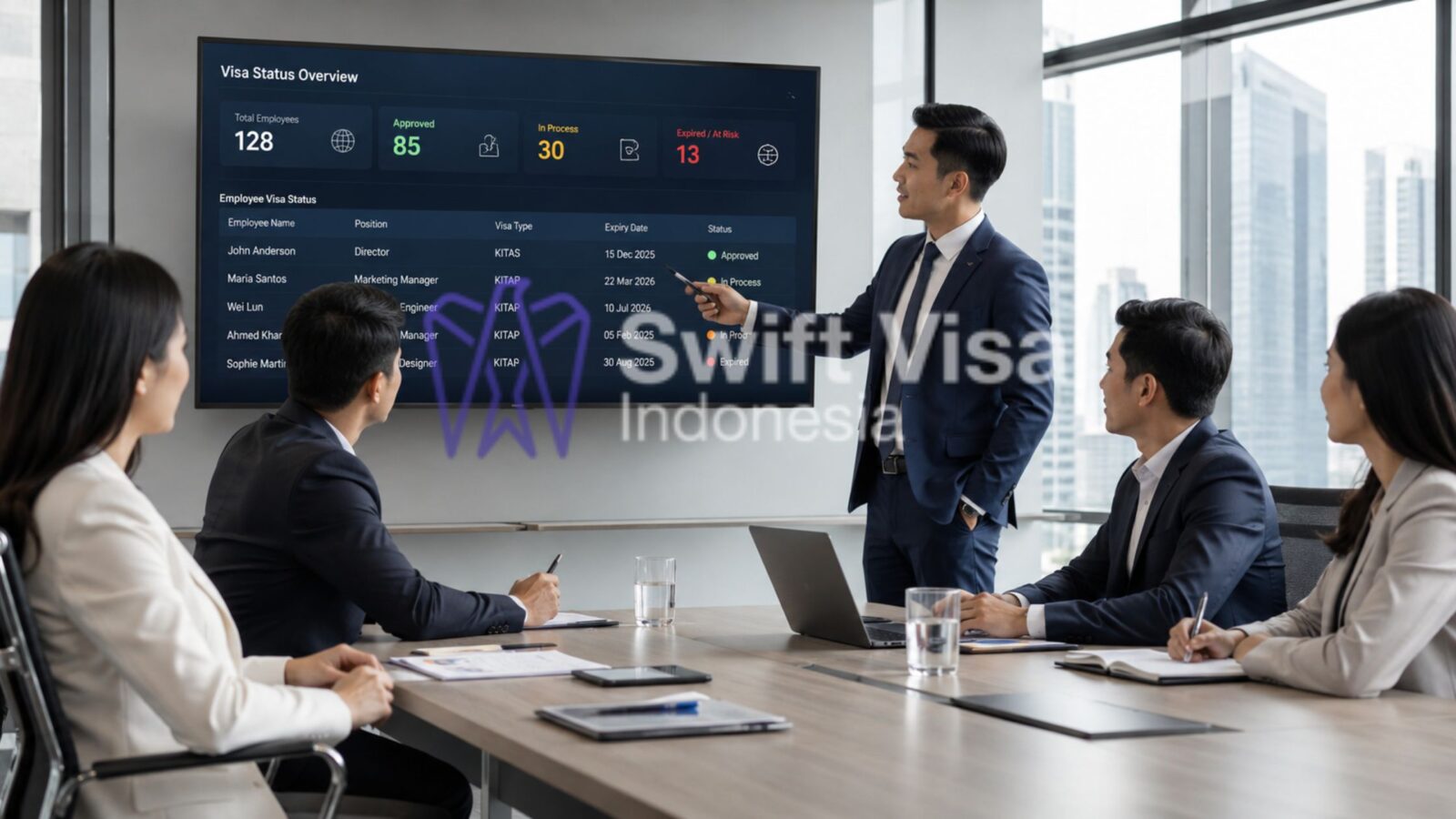
- Real-time permit status visibility a single view of every foreign employee or executive’s visa/KITAS status and expiry date, rather than checking individual files
- Automated renewal alerts flagged well before expiration, not discovered after the fact
- Integrated tax and BPJS tracking alongside visa status, since these obligations run in parallel for sponsored employees
- Audit-ready reporting that can be generated on demand rather than assembled reactively when a compliance review happens
A Practical Example
A multinational technology company expanding from Singapore to Jakarta needed to onboard 40 engineers, but their fragmented, per-employee visa process was causing delays. By centralizing the process RPTKA and KITAS approvals tracked through a single compliance workflow, with HR given direct dashboard access to monitor renewals the company completed all approvals within 45 days and passed a subsequent Ministry of Manpower audit with zero compliance findings. The difference wasn’t the underlying regulatory requirements, which stayed the same — it was moving from fragmented, per-case handling to a centralized system.
Frequently Asked Questions
Is there an official “Corporate Visa” category in Indonesian immigration law? No. The term is commonly used to refer to either a company-sponsored Business Visa or an Investor KITAS, depending on the situation neither is officially labeled “Corporate Visa” in regulation.
Can a company-sponsored Business Visa be extended into a Working Visa? Not automatically. A Business Visa and a Working KITAS follow separate application processes with different requirements moving from one to the other requires a fresh application through the appropriate pathway, not a simple extension.
How many foreign staff does a company need before centralized visa management becomes worthwhile? There’s no fixed threshold, but companies managing more than a handful of foreign staff or any number across multiple permit types (Business Visa, Working KITAS, Investor KITAS) typically find that centralized tracking pays for itself in avoided renewal gaps and reduced administrative time.
What happens if a visiting executive on a Business Visa is found doing hands-on operational work? This is treated as a serious immigration violation, since it crosses from permitted exploratory/administrative activity into unauthorized local employment. Consequences can include fines, deportation, and being blacklisted from re-entry for several years.
Getting Both Halves Right
Understanding what “Corporate Visa Indonesia” actually refers to prevents the wrong application from being filed in the first place. Managing it well afterward with centralized tracking rather than fragmented, per-employee handling is what prevents the renewal gaps and audit surprises that catch growing companies off guard.
For companies managing visa obligations across a growing foreign workforce, working with a corporate immigration consultant centralizes both the classification decision and the ongoing tracking in one place.
Need clarity on which visa type fits your situation, or want to centralize tracking for an existing foreign team? Contact Swift Visa Indonesia’s corporate consultation desk.