


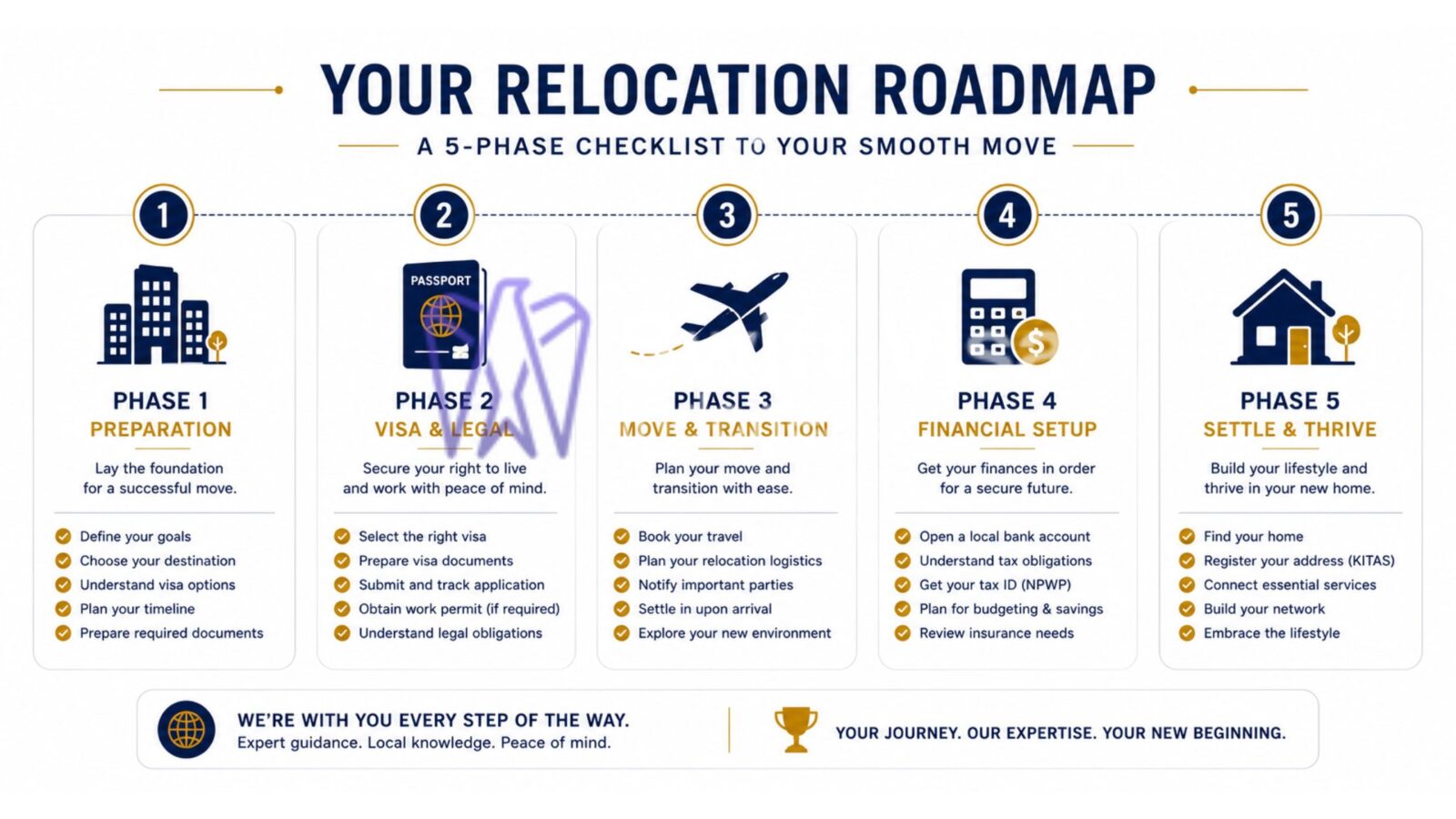
Most foreign corporations relocating staff to Indonesia engage separate providers for visas, legal setup, tax compliance, and housing logistics coordinating each one independently, often without realizing how much overlap exists between them. A unified view of Expat Services Indonesia changes that: it treats relocation as one connected operational system instead of four disconnected vendor relationships.
This checklist pulls together every piece a foreign corporation needs to verify before, during, and after relocating expatriate staff.
Phase 1: Pre-Relocation Legal and Corporate Foundation
Before a single employee boards a flight, the corporate structure needs to support the relocation:
- [ ] Confirm the company’s PT PMA structure permits sponsoring the work permits the relocation requires
- [ ] Verify the specific role isn’t on Indonesia’s restricted occupations list
- [ ] Confirm current NIB registration aligns with the organizational structure being used in permit applications
- [ ] Review tax and accounting obligations tied to expanded headcount, including payroll tax registration
Phase 2: Visa and Work Permit Sequencing
- [ ] File the RPTKA (Foreign Manpower Utilization Plan) before any individual work permit application
- [ ] Process the work visa (VITAS) and KITAS conversion in parallel with manpower approval where possible
- [ ] Distinguish clearly between roles needing a full work visa versus shorter-term business visa coverage
- [ ] For any remote or hybrid arrangement, confirm the employee isn’t defaulting to tourist visa status
Phase 3: Corporate Mobility for Executives and Short-Term Staff
- [ ] Map expected visit frequency for traveling executives to choose between single-entry and multiple entry business visas
- [ ] Confirm any entertainment, production, or event-related foreign staff are processed under the correct specialized visa category, not standard business visas
- [ ] Build a 60–90 day lead time buffer into all visa renewals tied to ongoing projects
Phase 4: Tax, Payroll, and Ongoing Compliance
- [ ] Establish a monthly compliance calendar covering corporate income tax, withholding, and VAT obligations
- [ ] Register expatriate employees correctly for payroll tax (PPh 21) and BPJS social security
- [ ] Maintain transfer pricing documentation for any intercompany payments connected to the relocation
- [ ] Schedule a mid-year compliance review separate from the annual filing cycle
Phase 5: Individual Expatriate Support
- [ ] Confirm health insurance coverage valid in Indonesia for relocating staff and dependents
- [ ] Provide housing and cost-of-living guidance specific to the assigned city (Jakarta, Bali, Surabaya, etc.)
- [ ] Support dependent visa applications alongside the primary employee’s work visa
- [ ] For senior staff approaching retirement age locally, flag the retirement visa pathway as a future transition option
Why Treating These as One System Changes Outcomes
Corporations that manage each phase through separate, uncoordinated vendors tend to discover problems at the worst possible time a tax compliance gap surfacing during an immigration audit, or a visa renewal stalling because the underlying NIB registration was never updated. Mapping all five phases against a single timeline, even when different specialists handle different pieces, prevents one phase’s oversight from quietly breaking another.
Run the Checklist Before Your Next Relocation, Not During It
Pull this checklist out before your next expatriate hire or executive transfer not midway through, once a renewal deadline or compliance gap forces urgency. A relocation planned against all five phases at once moves faster and creates far fewer compliance surprises than one handled phase-by-phase as problems arise.