


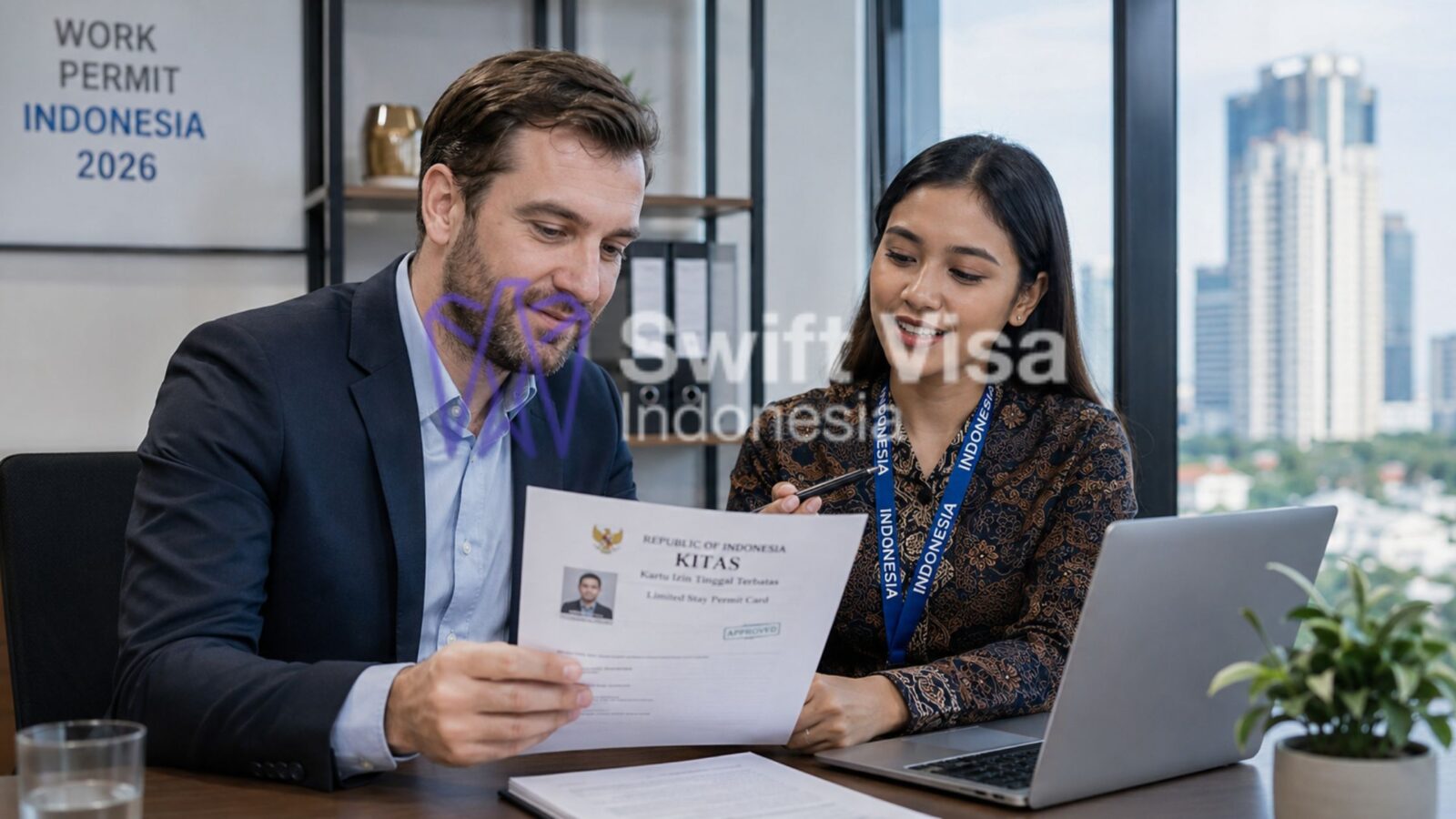
Every year, more foreign-owned and multinational companies expand their teams into Indonesia and nearly all of them hit the same wall: the Indonesia Work Permit process looks simple on paper but derails in practice. A missing signature on the RPTKA, a mismatched job title, or an underestimated timeline can push an executive’s start date back by weeks.
This guide consolidates everything HR teams and foreign employers need to know about securing an Indonesia Work Permit and Enterprise Work Permit in 2026 the legal framework, the four-phase process, a full cost breakdown, renewal requirements, and the regulatory updates that changed this year.
What Is an Indonesia Work Permit?
In Indonesian law, there is no single “work visa” document. Instead, a foreign national must hold two separate approvals issued by two different government bodies before they can legally work in the country:
- RPTKA (Rencana Penggunaan Tenaga Kerja Asing) — the Foreign Worker Utilization Plan. This is the Ministry of Manpower’s approval for a company to employ a specific foreign national in a specific role.
- KITAS/ITAS (Index C312) — the Limited Stay Permit issued by the Directorate General of Immigration, specifically coded for working stay purposes.
When companies or candidates search for a “work visa” or “Foreign Employee Visa Indonesia,” they are almost always referring to this RPTKA-backed C312 Working KITAS. The two institutions — the Ministry of Manpower (Kemenaker) and Immigration (Imigrasi) — each govern a different half of the process, which is why the paperwork can feel disjointed if you’re not prepared for it.
Who Needs a Work Permit — and Who’s Exempt
Any non-Indonesian citizen who intends to earn a salary, hold an official position, or perform paid professional duties inside Indonesia needs a work permit. This typically includes:
- Directors and Commissioners of a PT PMA (foreign-owned company)
- Technical experts, engineers, and specialists
- Foreign managers in hospitality, manufacturing, and technology
- Long-term contracted professionals and guest specialists
Permitted roles at the enterprise level generally include C-Suite executives, regional directors, managing partners, technical advisors, and specialized engineers. Restricted roles — where foreign nationals cannot be legally placed except in narrow advisory capacities — include Human Resource Management and Corporate Legal Affairs positions, along with most medical practice roles.
One exemption worth knowing: certain Directors or Commissioners who are also company shareholders may qualify for a simplified RPTKA pathway, since their role is treated differently from a standard employment position. This distinction is often missed by companies filing their first application, and it can save meaningful processing time if applicable to your case.
Important: You cannot legally work or earn income in Indonesia on a Tourist Visa or standard Business Visa. Doing so risks immediate deportation and blacklisting from future entry.
The Four-Phase Work Permit Process
The application is entirely employer-driven — a foreign worker cannot apply independently. Here’s how the process unfolds in practice.
Phase 1: RPTKA Application
The sponsoring company submits a request to the Ministry of Manpower justifying why the role requires a foreign hire rather than a local candidate. This includes defining the job’s position in the corporate hierarchy and outlining a counter-training plan — a commitment showing how a local Indonesian employee will eventually absorb the technical skillset from the foreign worker.
Phase 2: Notification and DKP-TKA Payment
Once the RPTKA is approved, Kemenaker issues a formal Notification confirming the approved employment duration. At this point, the company must pay the DKP-TKA (Dana Kompensasi Penggunaan Tenaga Kerja Asing) — a mandatory skill-development levy. The rate is a flat USD 100 per month per foreign worker, paid upfront for the full permit duration (for example, USD 1,200 for a 12-month permit).
Phase 3: e-Visa (VITAS) Issuance
With labor compliance cleared, Immigration issues an electronic visa — the VITAS (Visa Tinggal Terbatas) — allowing the foreign employee to legally enter Indonesia for work purposes.
Phase 4: Biometrics and KITAS Finalization
Upon arrival, the VITAS syncs automatically at the immigration checkpoint. Within days, the employee attends a local immigration office for biometric capture (photo and fingerprints), finalizing the physical or electronic KITAS.
Estimated Timeline by Phase
Phase | Estimated Processing Time | Authority |
| RPTKA Evaluation & Approval | 3–5 business days | Ministry of Manpower |
| Notification & DKP-TKA Payment | 1–2 business days | Central Government Bank |
| e-Visa (VITAS) Issuance | 4–7 business days | Directorate General of Immigration |
| Biometric Finalization (KITAS) | 3–5 business days | Local Immigration Office |
On paper, the full process spans roughly two to three weeks. In practice, document inconsistencies, tax-data mismatches, or last-minute regulatory adjustments routinely extend this. For enterprise-level relocations, start the application 45–60 days before the intended onboarding date.
Full Cost Breakdown
Most guides stop at the DKP-TKA levy, but that’s only one line item in the real cost of bringing a foreign employee onboard. A realistic budget should also account for:
- DKP-TKA levy: USD 100/month, paid upfront for the full permit term
- RPTKA administrative processing: varies by role complexity and industry sector
- Notarial and legal document preparation: required for company-side paperwork (deed of establishment, NIB, employment contract)
- Health/life insurance valid in Indonesia: a mandatory document from the foreign applicant, cost varies by provider
- Immigration office biometric appointment fees: minor, but often overlooked in budget planning
- Consultant or agency service fees (if used): varies by scope full end-to-end management typically costs more than a la carte document review, but reduces the risk of costly rejections and re-filing
Companies that budget only for the DKP-TKA levy are frequently surprised by the total when notarial, insurance, and administrative costs are added. Building these into the initial project budget avoids delays caused by last-minute funding approvals.
Document Checklist
From the sponsoring company:
- Company Deed of Establishment (Akta Perusahaan) and Ministry Approval (SK Kemenkumham)
- Business Identification Number (NIB) and relevant operational licenses
- Company Tax ID (NPWP) and the company director’s ID
- Draft employment contract
From the foreign applicant:
- Passport with at least 18 months of remaining validity
- University degree certificate relevant to the role
- CV demonstrating a minimum of 5 years of relevant experience
- Proof of health/life insurance valid in Indonesia
- Passport-style photo with a red background
Renewal: What Changes After Year One
A work permit isn’t a one-time filing — RPTKA and KITAS both carry expiration dates tied to the approved employment duration, and renewal needs to be initiated before they lapse. Key points HR teams should track:
- Start the renewal process at least 30 days before expiration to avoid a compliance gap
- The DKP-TKA levy is paid again for the new permit term — it is not a one-time cost
- Any change in job title, role scope, or reporting structure since the original filing should be flagged and reflected in the renewal application, not left unreported
- Late renewals risk fines and, in repeated cases, can affect the company’s standing for future RPTKA applications
2026 Regulatory Notes for HR Teams
Indonesia’s expatriate placement framework continues to be actively enforced, with immigration and labor authorities cross-checking company data against the OSS (Online Single Submission) system more closely than in previous years. Practical implications for HR teams:
- Ensure company data on OSS is fully synchronized with what’s submitted to immigration — mismatches are a common cause of delays
- Job title and RPTKA role descriptions should match actual duties precisely; generic titles increase scrutiny
- Regional variation in processing exists between Jakarta, Bali, and other economic hubs — local counsel or a consultant familiar with the specific immigration office can shorten turnaround
A Practical Example
A technology company opening a Bali office needs to bring in a specialized AI engineer from Europe. The company’s HR team initiates the RPTKA application 50 days before the planned start date, budgets for the DKP-TKA levy plus notarial and insurance costs upfront, and works with immigration counsel familiar with the local office to avoid the regional processing variation mentioned above. The permit clears with several days to spare — a buffer that would not have existed had the process started at the more commonly assumed 2–3 week timeline.
Frequently Asked Questions
Can a foreign employee start working before the KITAS is finalized? No. Legal work authorization begins only once the full four-phase process, including biometric finalization, is complete.
Is the DKP-TKA levy refundable if an employee leaves early? Generally no it is paid upfront for the approved duration regardless of early termination, though specific circumstances should be confirmed with current regulations.
Does a company need a new RPTKA for every foreign employee, or can one cover multiple hires? Each role and position typically requires its own RPTKA filing, even within the same company.
What happens if a work permit expires before renewal is filed? The employee’s legal work status lapses, creating compliance risk for both the employee and the sponsoring company. Renewal should always be initiated well before expiration.
Getting It Right the First Time
The Indonesia Work Permit process rewards preparation. Companies that map out their document requirements, budget for the full cost not just the DKP-TKA levy and build in a realistic timeline buffer consistently avoid the delays that catch first-time filers off guard.
For companies managing multiple expatriate placements at once, or without an in-house global mobility team, working with a corporate immigration consultant can reduce this administrative load significantly from OSS data synchronization to tracking renewal deadlines across an entire foreign workforce.
Ready to bring your international team onboard without the administrative friction? Contact Swift Visa Indonesia’s corporate consultation desk to plan your Enterprise Work Permit strategy today.