

Bali has been the world’s most popular destination for digital nomads for the better part of a decade. The coworking spaces in Canggu, the rice field cafes in Ubud, the villa setups in Seminyak it all looks effortless on Instagram. But in 2026, working from Bali without the right visa is no longer a gray area. It is a risk with real consequences: fines, deportation, and multi-year bans from entering Indonesia.
This guide gives you the straight facts no filter. If you are an American, European, British, Australian, or any other Western national planning to work remotely from Bali, here is exactly what is legal, what is not, and what you need to do to protect yourself.
The Short Answer: It Depends on Your Visa
Working remotely from Bali is legal but only on the right visa. The type of work you do and the visa you hold are what determine whether you are operating inside or outside Indonesian immigration law.
Here is the clearest version of the rules:
| Your Situation | Legal Status |
| Working remotely for a foreign company on a valid E33G KITAS | ✅ Legal |
| Freelancing for clients outside Indonesia on a valid E33G KITAS | ✅ Legal |
| Working remotely on a tourist visa (VOA or B211A) | ❌ Illegal |
| Working for an Indonesian company without a Work KITAS | ❌ Illegal |
| Earning income from Indonesian clients or sources on any KITAS | ❌ Illegal |
| Running a business that earns Indonesian-source income without a PT PMA | ❌ Illegal |
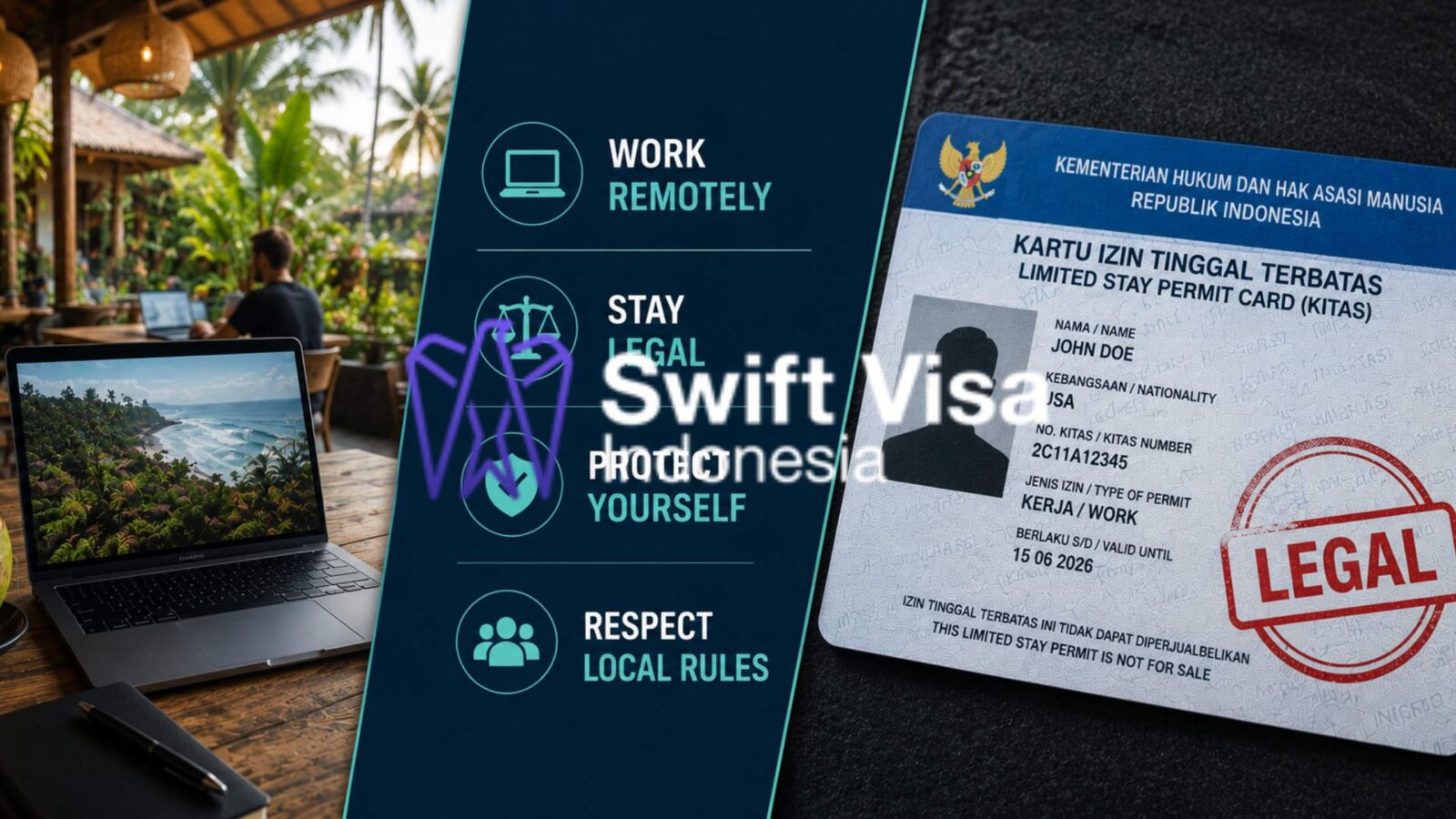
The bottom line: the E33G Remote Worker KITAS is the only legal pathway for digital nomads in Bali. Everything else including the B211A social visa that remote workers quietly used for years is no longer a safe option in 2026.
What Changed in 2026: Bali’s Enforcement Crackdown
For years, “work from Bali on a tourist visa” was an open secret. Immigration enforcement was minimal, and most remote workers operating on VOAs or B211As faced little scrutiny. That era is over.
In April 2026, Bali’s Regional Immigration Office launched the Dharma Dewata Immigration Patrol Task Force a dedicated unit of approximately 100 officers deployed island-wide, specifically targeting foreigners working illegally. The results were immediate.
Within the first three weeks of operations, 62 foreign nationals were detained for violations including illegal work on tourist visas, overstays, and falsified documents. Patrols are concentrated in Bali’s most popular digital nomad hubs: Canggu, Ubud, Seminyak, Kerobokan, and Uluwatu.
Authorities are not limiting enforcement to coworking space raids. Immigration officers are actively monitoring public social media if you post “working from Bali” tags on Instagram, LinkedIn, or TikTok while holding a tourist visa, you are generating evidence against yourself.
Bali’s Regional Immigration Office has made its position clear: “Foreigners who carry out activities that do not comply with their stay permit will face firm action.”
This enforcement push is part of Indonesia’s broader pivot toward a “quality tourism” model one that favors visitors who contribute to the formal economy through proper visa channels.
The Penalties for Getting It Wrong
This is not a warning you can afford to ignore. The consequences of working illegally in Bali in 2026 are severe and fast-moving.
Penalties include immediate visa cancellation, fines, deportation, and re-entry bans ranging from several years to a lifetime blacklist in serious cases.
A timeline of what typically happens if you are caught:
- Day of detention: Your visa is cancelled on the spot. You are taken to an immigration holding facility.
- Within 3–7 days: A deportation order is issued. You are escorted to Ngurah Rai Airport and placed on a flight out of Indonesia.
- Immediately after deportation: A re-entry ban is placed on your passport. Depending on the severity of the violation, this can range from 6 months to a permanent lifetime ban.
- Long-term: The deportation record follows your immigration history and can affect visa applications in other countries.
Indonesian authorities have also made clear that ignorance of the rules is not a valid defense. “Lack of knowledge of the rules will not ward off punishment,” according to the 2026 enforcement guidelines.
The Legal Route: Indonesia’s Remote Worker Visa (E33G)
The E33G Remote Worker KITAS was implemented on April 1, 2024, specifically designed for foreign nationals who want to live in Indonesia while working remotely for employers based outside the country. It is valid for up to one year, with the option to renew for a second year.
This is the visa every legitimate digital nomad in Bali should hold in 2026. Here is the complete breakdown.
Who Qualifies for the E33G
To be eligible, you must be employed by a foreign company registered outside Indonesia and earn a minimum annual income of at least USD 60,000. Freelancers are eligible, but must demonstrate consistent foreign-sourced income at the same threshold.
Any form of local employment, business activity, or earning income from Indonesian sources is not permitted under the E33G and would lead to penalties or cancellation of your stay.
Documents Required for the E33G Application
You will need to gather the following before starting your application:
- Passport valid for at least 6 months from your intended entry date, with sufficient blank pages
- Bank statement showing a minimum balance of USD 2,000, covering the last 3 months
- Passport-sized photograph — recent, colour, against a white or plain background
- Curriculum Vitae (CV) detailing your professional background and current role
- Employment contract — current, signed contract with your foreign employer confirming your role and salary
- Travel itinerary — planned entry date and initial accommodation details
- Proof of income — payslips, tax returns, or official employer confirmation showing annual income of at least USD 60,000
Freelancers without a traditional employment contract should compile client contracts, invoices, and bank transfer records to demonstrate consistent foreign-sourced income.
E33G Costs and Processing Time
The official government fee (PNBP) for the E33G is IDR 7,000,000, with an additional IDR 6,000,000 service fee bringing the total government cost to IDR 13,000,000 (approximately USD 820). When combined with agent fees and KITAS processing, the realistic total for the first year is typically USD 800–1,200 depending on your situation.
Processing time with a professional immigration agent typically runs 5–14 working days from the moment your complete document set is submitted.
What the E33G Allows You to Do
Once you hold a valid E33G KITAS, you are legally entitled to:
- Live in Indonesia for up to 1 year from your entry date
- Travel freely in and out of Indonesia via a Multiple Exit Re-entry Permit (MERP), which is included with the E33G — there is no limit on the number of trips
- Bring dependent family members under a spouse or child KITAS, matched to the same validity period as your visa
- Work from any location in Indonesia — Bali, Jakarta, Lombok, or anywhere else
What the E33G Does Not Allow
The E33G does not grant the right to work for or receive payment from individuals, companies, or organizations based in Indonesia whether full-time or part-time. If you wish to work for an Indonesian employer, you must obtain a Work KITAS (E28A/E23) sponsored by that company.
The Tax Situation: What Nobody Warned You About
Working legally in Bali is one thing. Your tax obligations are another and this is the area where most Western nomads are caught completely unprepared.
Under Indonesian tax regulations introduced at the end of 2025, immigration officers now apply stricter scrutiny to KITAS holders regarding tax residency. Indonesia’s standard threshold is 183 days in a calendar year spend more than 183 days in Indonesia and you may be considered a tax resident, meaning Indonesia can tax your worldwide income.
The practical implications for E33G holders:
- Under 183 days: Generally not considered a tax resident. Your foreign income is typically not taxable in Indonesia.
- Over 183 days: You may be required to register as a tax resident and file an Indonesian tax return. Indonesia’s progressive income tax rate goes up to 35% for high earners.
- Double Taxation Agreements (DTAs): If your home country has an active DTA with Indonesia, you may be able to claim tax credits for taxes paid in one country against your liability in the other. The US, UK, Australia, and most EU member states have DTAs with Indonesia but the details vary significantly by country.
The recommendation: If you plan to stay in Indonesia on an E33G for the full 12 months, consult a cross-border tax adviser before you arrive. Tax planning in advance costs far less than back-taxes, penalties, and the complexity of filing in two jurisdictions simultaneously.
What About the B211A? Can I Still Use It?
The B211A Social-Cultural Visa was historically the visa of choice for remote workers who wanted more than 60 days in Bali without committing to a full KITAS. In previous years, immigration officers generally looked the other way.
Enforcement has become significantly more visible in 2026. Violations on a B211A including any form of remote work can lead to fines, deportation, or bans from re-entry.
The B211A remains a valid visa for genuine social and cultural purposes (language study, cultural immersion, retirement visits). It is not a safe option for anyone doing paid remote work, regardless of where their clients or employer are based.
If you are currently in Bali on a B211A and working remotely, the safest course of action is to convert to an E33G KITAS through the Visa Bridging system before, not after, enforcement reaches you.
Influencers and Content Creators: A Separate Risk Category
The 2026 enforcement crackdown specifically targets social media influencers, content creators, and individuals performing activities in the gray area including unpaid volunteering, hosting wellness workshops, DJing, and photography for commercial purposes.
If you are a content creator who monetizes your Bali content through brand deals, sponsorships, YouTube AdSense, or affiliate income even if your audience is entirely outside Indonesia you are engaging in professional activity that Indonesian immigration classifies as work.
The appropriate visa for professional content creators is a Creative KITAS, not the E33G. The distinction matters: an E33G holder caught doing commercial content creation in Indonesia could face visa cancellation on the grounds that their activity exceeds the scope of their permit.
If this applies to you, contact Swift Visa Indonesia for a consultation to determine the correct visa type for your specific situation.
Gray Areas: Honest Answers to Hard Questions
“I do a few hours of consulting calls per week. Does that count as work?” Yes. Any professional activity calls, emails, deliverables that generates income falls under Indonesia’s definition of work. The volume or hours are not the determining factor; the commercial nature of the activity is.
“My employer pays me into a foreign bank account. Does Indonesia even know?” Indonesian immigration does not need to audit your bank account to catch you. Social media posts, LinkedIn profiles, coworking space check-ins, and reports from other visa holders have all been used as enforcement evidence in 2026.
“I heard the E33G is hard to get. Is it worth the effort?” With a professional immigration agent handling your application, the process is straightforward. The document list is specific but not unusually demanding compared to other long-stay visa programs. The “difficulty” most people encounter comes from attempting to navigate the process without professional support.
“Can I apply for the E33G while already in Bali?” Yes through the Visa Bridging system. If you are currently in Bali on a VOA or B211A, you can apply for a Bridging Visa and convert to an E33G without leaving the country, provided your current visa has not expired. The Bridging Visa grants 60 additional days of legal status during the transition.
Common Mistakes That Lead to Deportation
After processing hundreds of E33G and KITAS applications, the Swift Visa team has identified the most frequent errors:
- Posting publicly about remote work while on a tourist visa. This is the fastest way to attract immigration attention in 2026.
- Assuming enforcement targets other people, not you. The Dharma Dewata Task Force does not distinguish between nationalities or professions.
- Waiting until your current visa expires to start the E33G process. Processing takes time. Begin at least 30 days before your current status expires.
- Submitting bank statements that do not clearly show foreign-sourced income. The E33G application is reviewed carefully. Vague or inconsistent financial documents are the number one cause of delays.
- Thinking the B211A extension resets your legal work status. It does not. Extending a tourist visa does not change its permitted activities.
How Swift Visa Indonesia Handles E33G Applications
Swift Visa Indonesia processes E33G KITAS applications end-to-end from document review and preparation through to submission, tracking, and collection of your KITAS card.
What we do differently:
- Pre-submission document audit: We review your income proof, employment contract, and bank statements before submitting anything to immigration eliminating the most common causes of delay.
- Direct government access: Our team has established relationships with immigration authorities that speed up processing significantly compared to self-application.
- Visa Bridging coordination: If you are already in Bali and need to convert your existing visa to an E33G without leaving, we manage the entire Bridging Visa process.
- Family KITAS: If you are bringing a spouse or children, we handle dependent KITAS applications alongside your own.
Ready to get your status sorted before the next patrol reaches your coworking space? Book a free consultation with Swift Visa Indonesia. Tell us your current visa status, your work situation, and your timeline — and we will tell you exactly what to do next.
Quick Reference: E33G Remote Worker Visa at a Glance (2026)
| Category | Detail |
| Official name | E33G Remote Worker KITAS |
| Introduced | April 1, 2024 |
| Valid for | Up to 12 months from entry |
| Renewable | Yes — 1 additional year |
| Minimum income | USD 60,000/year (foreign-sourced) |
| Employer requirement | Foreign company, registered outside Indonesia |
| Multi-entry | Yes — MERP included |
| Dependents | Spouse and children KITAS available |
| Government fee | IDR 13,000,000 (~USD 820) |
| Total first-year cost | ~USD 800–1,200 (with agent) |
| Processing time | 5–14 working days (with agent) |
| Can earn Indonesian income | ❌ No |
| Can work for Indonesian employer | ❌ No |
| Tax threshold | 183 days triggers potential tax residency |
Frequently Asked Questions
Q: Is working remotely from Bali on a tourist visa illegal? Yes. Working remotely — including for companies and clients based entirely outside Indonesia — is not permitted on a Visa on Arrival or B211A social visa. The E33G Remote Worker KITAS is the only legally recognized visa for remote workers in Bali.
Q: What happens if I am caught working on a tourist visa in Bali? Consequences include immediate visa cancellation, fines, detention, deportation, and a re-entry ban ranging from several years to a lifetime blacklist. Enforcement increased significantly in 2026 with the launch of the Dharma Dewata Immigration Patrol Task Force.
Q: Can I apply for the E33G while I am already in Bali? Yes. You can apply for a Bridging Visa to legally stay in Indonesia while your E33G application is processed. Applications must be submitted before your current visa expires. Swift Visa Indonesia manages this process end-to-end.
Q: What income do I need to qualify for the E33G? A minimum annual income of USD 60,000 from a foreign employer or clients based outside Indonesia. You will need to provide payslips, tax returns, an employment contract, and 3 months of bank statements showing consistent income.
Q: Do I need to pay tax in Indonesia on my E33G? If you spend more than 183 days in Indonesia in a calendar year, you may be classified as an Indonesian tax resident, which means Indonesia can tax your worldwide income. Consult a cross-border tax adviser before your stay if this applies to you. Many countries have Double Taxation Agreements with Indonesia that may reduce your liability.
Q: Can I bring my family to Bali on the E33G? Yes. Your spouse and children can apply for dependent KITAS permits that match the validity of your E33G. Swift Visa Indonesia handles family applications alongside the primary E33G application.
Q: Is the E33G available for freelancers, not just salaried employees? Yes. Freelancers are eligible for the E33G, but must demonstrate consistent foreign-sourced income of at least USD 60,000 per year through client contracts, invoices, and bank transfer records.